A taxi or Uber from Sydney Airport to the CBD emits 1.58 kg CO₂.

The Airport Link train emits 0.32 kg.
The train is also faster. And $25 cheaper. 
Yet most passengers still choose rideshare.

Not because it's the better option but because nobody presents the alternatives at the exact moment travelers make the decision. 
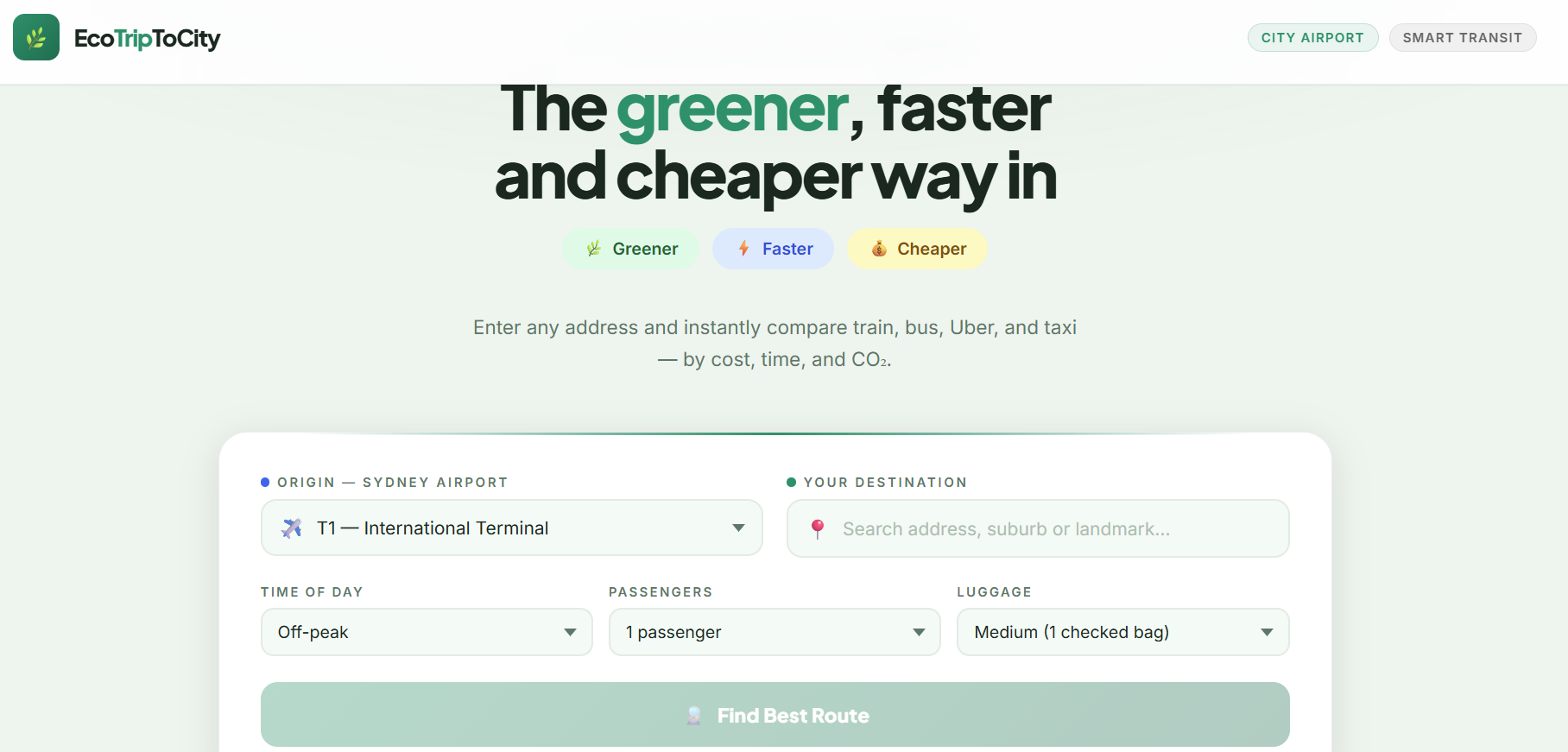
That's the problem behind EcoTripToCity.

Before departure and again when passengers land, airlines and airports can show train, bus, and rideshare options side by side: cost, travel time, and CO₂ emissions. Passengers who choose lower-emission transport earn loyalty points.
Or redeem points to pay for public transport directly. 

For airlines and airports, every journey feeds a shared Scope 3 dashboard, making airport-city transport emissions visible, attributable, and audit-ready for the first time. 

At Sydney Airport alone, a 5% shift from rideshare to rail could avoid an estimated 2.8 million kg of CO₂ annually. 

So we built a solution. Click on the image below to test.

Looking to speak with airline, airport, loyalty, and transport leaders interested in testing whether traveler incentives can drive measurable behavior change.


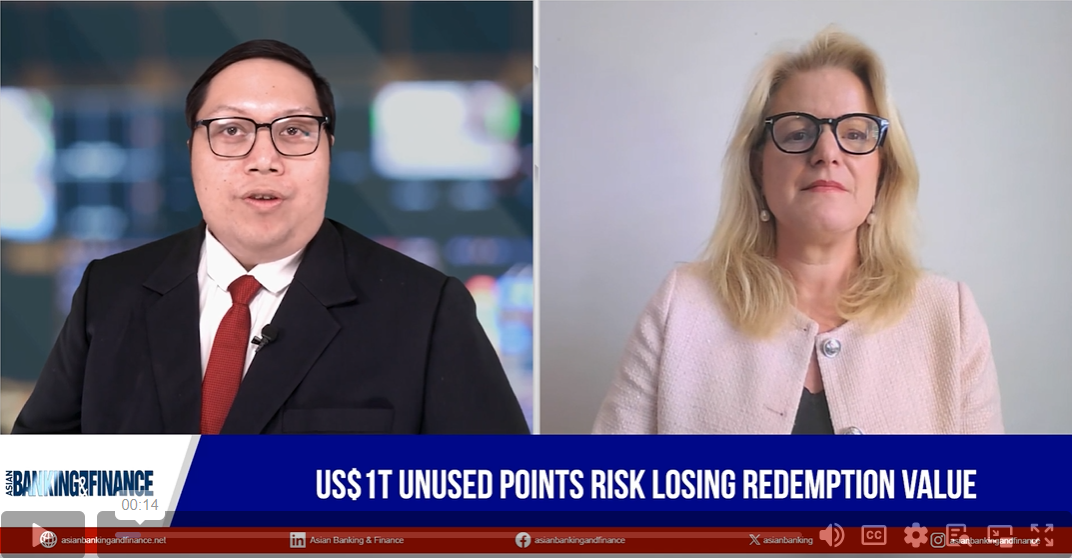
US$1t unused points risk losing redemption value

Almost US$1 trillion in airline and hotel loyalty points is sitting unused globally.

The question is: who really controls that value?I'm delighted to share my latest interview with Asian Banking & Finance, where I discuss why loyalty points are evolving from a marketing reward into something much closer to a financial asset.Globally, hundreds of millions of travellers are accumulating points across airline and hotel programmes, yet many don't realise that the value of those points can change through expiry policies, redemption rule changes, and programme devaluations.

In the interview, we explore:
Why airline and hotel loyalty programmes increasingly resemble large financial ecosystems
How consumers can lose value when points sit idle or redemption rules change
Why loyalty balances may become relevant in tax, estate planning, divorce settlements, and corporate reporting
How AI could transform the way travellers and businesses evaluate points versus cash decisions in real time here is also an important

Australian angle. As Australia prepares for major RBA payment reforms, a bigger question is emerging: what happens to loyalty economics when the revenue streams that help fund rewards programmes come under pressure? The next phase of loyalty may not just be about earning more points but understanding how quickly their value can change.The travel industry has spent decades helping travellers earn points.

The next decade may be about helping them understand, value, and actively manage those points.

Thank you to Asian Banking & Finance for highlighting this important discussion.

Click on the video to watch in full.

99% of an Airport’s Emissions Aren’t the Airport’s Problem. Until Now.

A new compliance clock is ticking across Australian boardrooms….

Australia’s Climate-Related Financial Disclosure (CRFD) regime commenced on 1 January 2025, establishing Australia as a global leader in mandatory climate reporting aligned to International Sustainability Standards Board standards. Compliance is being phased in from the largest companies first, with Scope 3 emissions — the full value chain — becoming mandatory from the second year of reporting.

For airlines and airports, this is not an abstract regulatory exercise. It is an existential data problem.

The Scope 3 Problem Nobody Wants to Name

Scope 1 and 2 emissions  (what you burn directly and what your energy supplier burns) are hard but solvable. Scope 3 is something else entirely. As per Brisbane Airport Corporation’s own reporting, 99% of their overall emissions fall within Scope 3, owned by airport stakeholders with primary contributors including aviation fuel, ground servicing equipment, passenger transportation to and from the airport, and third-party electricity consumption.

Read that again. Ninety-nine percent.

This means airports cannot hit their climate targets without fundamentally changing how they influence, measure, and report on the behaviour of every party in their ecosystem airlines, ground handlers, tenants, rideshare operators, passengers.

What the Ecosystem Is Actually Doing

The moves being made are significant, but fragmented.

In May 2025, Sydney Airport earned Airport Carbon Accreditation Level 4, signed an MoU with Qantas to develop a domestic Sustainable Aviation Fuel (SAF) industry, and participated in the largest-ever commercial importation of SAF into Australia, nearly two million liters. Bold infrastructure moves. But SAF addresses Scope 1 aviation emissions. It does nothing for the passenger who drove a diesel SUV to the terminal.

Brisbane Airport became one of the first Australian airports to achieve net zero Scope 1 and 2 emissions in January 2025, reducing emissions by 97% through renewable electricity procurement and electrification of ground fleet vehicles. Again commendable, but Scope 1 and 2 is the easy part.

On the ground transport side, Uber for Business now gives companies the ability to track, report and act on ground transportation carbon emissions including total CO2 and the percentage of corporate rides taken with low-emission options. Trip-level data. Useful. But siloed.

And then there’s Qantas. After pioneering Green Tier in 2022 to reward members for sustainable choices, the airline is phasing out Green Tier from late 2026, while stating it will “consider new ways to reward members who make sustainable choices when they fly.” The sustainability intent remains. The mechanism is being rebuilt from scratch.

The Gap Nobody Is Filling

What you see across this landscape is effort without integration. Airports measuring their fence line. Airlines measuring their fuel. Rideshare operators measuring their fleet. Loyalty programs measuring individual acts.

Nobody is measuring the journey.

A traveller flies Sydney to Singapore. They took an Uber to the airport, parked for a week, bought a coffee from a non-certified supplier in the terminal, offset their flight at checkout, and stayed in a hotel with no energy rating. That is a Scope 3 emissions story and right now, no single actor in that chain can tell it end to end.

Under the CRFD regime, the obligation to tell it is coming. Entities must disclose Scope 3 emissions from the second year of reporting, using all reasonable and supportable information available including information provided by customers, suppliers, or otherwise publicly available.

“All reasonable and supportable information.” That phrase will define a new category of competitive advantage.

What Good Looks Like

The travel operators who will lead this decade are not those who reduce their own footprint most aggressively. They are those who build the data infrastructure to measure, attribute, and improve the footprint of every interaction in their ecosystem and who turn that infrastructure into a better experience for the traveler.

Loyalty is the most underutilised lever in this equation. Airlines and airports already have the identity layer, the transaction layer, and the engagement mechanism. The question is whether they will use it to make sustainable choices visible, rewarding, and habitual or whether they will wait for regulation to force their hand. The obligation is no longer invisible. The tools to meet it are emerging. The organisations that move now, before the reporting deadline arrives,  will shape the standard. Those that wait will be shaped by it.

tribuescape_scope3_article

Uber just became a travel company.

Uber just became a travel company.

Yesterday, Uber announced hotel bookings (700,000 properties via Expedia), a Travel Mode* with personalised local recommendations, and AI-powered voice booking. This collaboration aims to transform Uber into a “super app” for travel.

Dara Khosrowshahi called it Uber’s “personal concierge for travel.”

Of course he did.

Before leading Uber, Dara was CEO of Expedia for 12 years.

This partnership isn’t a vendor deal.
It’s a founder’s unfinished vision finally with the platform to execute it at scale.

But here’s what I see beyond the headline:

This isn’t a product launch.
It’s a loyalty land grab.

Uber One members get 10% back in credits on every hotel booking.
At least 20% off 10,000+ hotels.
Credits that accumulate and carry home with you.

That’s not a discount. That’s a closed-loop economy designed to make you never leave the app.

I wrote a few months ago that loyalty has quietly become a financial asset class in travel earned, redeemed, traded, monetised. That the real battleground was no longer the fare or the room rate.

It was the behavioural data underneath.

Uber just proved it.

Think about what Uber now holds:
→ Where you go (rides)
→ What you eat (Eats)
→ How you move when you travel (airport transfers, hotel runs)
→ And now where you sleep

That is an extraordinarily complete picture of a traveler.
And with AI across all of it, that data doesn’t just inform. It predicts. It sells. It retains.

The travel industry thought its biggest competitive threat was OTAs vs. direct booking.

The real disruption was always going to come from platforms that already owned daily life and decided travel was next through smart partnerships.

Flight Centre did it with Rewards360 allowing travelers to double or triple dip on points.
Qantas overhauled FF in response.
Revolut bought a Lufthansa AI agent.
Commonwealth Bank partnered with

Hopper to offer lifestyle, travel and financial services
Now Uber has Expedia and the CEO who built it.

The traveler is not the customer anymore.
The traveler is the currency.

Will this land in Australia? Uber One is already live here. The infrastructure is in place. My bet: H2 2026.

And when it does, Australian travel brands need to ask themselves a hard question: what do you own about your traveler that Uber doesn’t?

I unpacked the loyalty-as-currency shift in full a few months ago — link in the comments. Would love your take. 👇

*Travel Mode: A new app experience featuring OpenTable restaurant reservations, local recommendations, and “room service” deliveries.

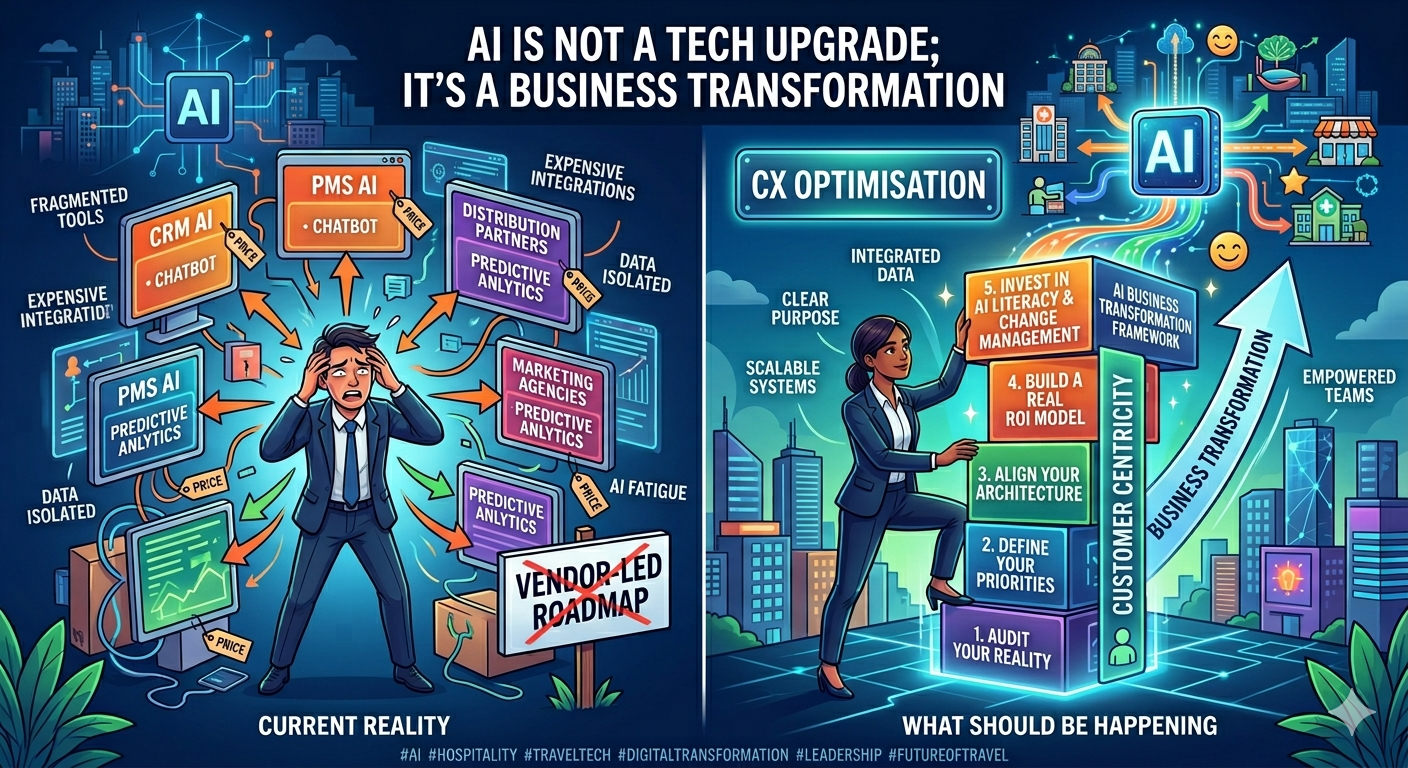
AI isn’t a tech upgrade, it’s a business transformation.

Everyone says they’re “doing AI.” or are building an “AI-Led business”.

Six months in. Do I say it? Yes, because someone has to. Hospitality, travel, wellness, entertainment, mobility need to wake up.

What I see across hotels, spas, lifestyle apps, and travel sellers is this:
You’ve outsourced your AI thinking.
To your CRM.
To your PMS
To your distribution partners.
To your marketing agencies.
And now they’re selling you their version of AI, not yours.

Instead of asking:
“What problems are we solving? What value are we creating?”
We hear:
“What AI features can our vendors offer?”

The result?
Fragmented tools with no clear purpose
Expensive integrations that don’t scale
Data that still doesn’t talk to each other
“AI capabilities” that nobody uses. Teams already showing signs of AI fatigue

Most organisations do NOT have:
- an AI capabilities and readiness audit
- a clear strategy and risk assessment and mitigation plan
- a prioritised roadmap
- an architecture that makes sense
- a change management framework
- a business case tied to CX optimisation, revenue or efficiency

The risk? You buy what’s available, you implement what’s sold.
Meanwhile, your people are undertrained, overwhelmed, scared and increasingly Resistant.

AI is not a tech upgrade. It’s a business transformation and right now, most of the industry is trying to plug AI into broken processes, legacy systems, and unclear strategies.

What should be happening instead? Before buying anything:
- Audit your reality
- Define your priorities
- Align your architecture
- Build your roadmap with a real ROI model attached especially around CX
- Invest in AI literacy and change management
In that order.

If your AI strategy is defined by your PMS, Aggregators and retailing platforms or your CRM…You don’t have an AI strategy, you have a vendor roadmap.

How AI and digital visibility are reshaping hospitality performance

Why digital visibility is becoming critical to hospitality performance

Hospitality operators across Australia are navigating a period of sustained pressure. Margins are tightening, labour remains constrained, and fuel and input costs continue to rise, while demand patterns are increasingly unpredictable. Industry-wide, labour shortages, wage pressure and cost inflation remain among the most significant challenges facing operators.

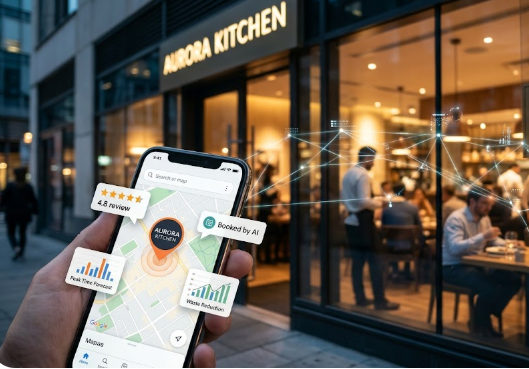
At the same time, platform dependency and online reviews are exerting a growing influence on revenue. However, beyond these immediate pressures, a more structural shift is underway. Increasingly, a venue is judged on a screen before it is experienced in person.

Discovery is evolving

The way customers discover and choose hospitality venues is changing rapidly. Traditional drivers such as location and foot traffic are being overtaken by digital search, reviews, and platform-driven recommendations.

This shift is expected to accelerate with the rise of artificial intelligence. Research indicates that 74% of diners are already comfortable using AI to manage reservations, while 47% of businesses expect AI-driven search and personalisation to reshape how customers book and engage.

For operators, this means digital visibility is no longer a marketing layer. It is becoming core to demand generation.

Technology adoption is accelerating under pressure

This transformation is occurring alongside increasing operational strain.

Across the sector, 42% of hospitality SMEs are already using AI to manage costs and operations. Adoption is even more pronounced at the venue level, with 65% of restaurants reporting some level of AI deployment, and 99% of those seeing measurable benefits, particularly in reducing labour time, improving forecasting, and minimising waste.

These gains are not incremental. They are becoming essential as businesses seek to maintain margins in a high-cost environment. Digital capability is therefore shifting from optional to foundational.

From foot traffic to feedback loops

As discovery becomes digital, growth dynamics are also changing.

Three capabilities are emerging as critical:

Visibility and recommendation
Venues must be consistently visible across platforms and maintain strong digital reputations. In an environment driven by rankings and recommendations, absence from search or weak reviews can materially impact demand.

Repeat visitation
With acquisition costs rising, repeat customers are becoming more valuable. Data shows that 74% of diners are more likely to return after a personalised or memorable experience, highlighting the importance of customer data, loyalty strategies, and targeted engagement.

Operational efficiency
AI and digital tools are increasingly being used to streamline administrative tasks, optimise staffing, reduce no-shows, and improve booking management. The objective is not to replace staff, but to enable teams to operate more effectively in a constrained labour market.

A structural shift, not a temporary cycle

The current environment is not defined by a single challenge, but by the convergence of several:

  • margin compression
  • operational complexity
  • and increasing reliance on digital channels

Operators are not simply managing through a cycle. They are adapting to a different operating model.

Positioning for the next phase

Businesses that perform strongly in this environment are likely to focus on three priorities:

  • strengthening cost control through better systems and data
  • building direct customer relationships, reducing reliance on third-party platforms
  • and actively managing how they appear in digital and AI-driven discovery environments

Final thought

Before a customer experiences a venue, they experience its digital presence.

In that sense, “taste” now begins well before the table.

For hospitality operators, the question is no longer only about product quality. It is also about visibility, relevance, and consistency in an increasingly digital and AI-influenced market.


𝐓𝐡𝐞 𝐍𝐞𝐱𝐭 𝐒𝐪𝐮𝐞𝐞𝐳𝐞: 𝐇𝐨𝐬𝐩𝐢𝐭𝐚𝐥𝐢𝐭𝐲 𝐚𝐧𝐝 𝐓𝐫𝐚𝐯𝐞𝐥 𝐆𝐫𝐨𝐰𝐭𝐡 𝐈𝐬 𝐂𝐡𝐚𝐧𝐠𝐢𝐧𝐠

𝐌𝐨𝐬𝐭 𝐀𝐫𝐞𝐧’𝐭 𝐑𝐞𝐚𝐝𝐲

Pressure has returned across hospitality, wellness, and travel.

Costs are up, uncertainty is high, and margins are tighter. Yet many businesses are still trying to grow using pre-2020 playbooks.

𝐆𝐫𝐨𝐰𝐭𝐡 𝐈𝐬𝐧’𝐭 𝐀𝐛𝐨𝐮𝐭 “𝐌𝐨𝐫𝐞” 𝐀𝐧𝐲𝐦𝐨𝐫𝐞

For years, growth meant: more bookings, more guests, more expansion. Today, that model is under strain.

  • Acquiring customers is more expensive
  • Guests have endless choice
  • Loyalty is harder to secure
  • Cost bases have increased

The businesses adapting have made a clear shift:

From chasing volume to maximising value per guest

𝐀 𝐍𝐞𝐰 𝐃𝐢𝐯𝐢𝐝𝐞 𝐈𝐬 𝐄𝐦𝐞𝐫𝐠𝐢𝐧𝐠

It’s not between large groups and small operators. It’s between those who have modernised and those who haven’t.

Leading businesses are already:

  • simplifying how guests discover, book and engage
  • offering relevant upgrades and add-ons
  • packaging rooms, services and experiences
  • reducing manual work through automation

Others are still dealing with:

  • fragmented tools
  • manual processes
  • missed revenue opportunities
  • limited visibility on guest behaviour

𝐓𝐡𝐞 𝐑𝐞𝐚𝐥 𝐎𝐩𝐩𝐨𝐫𝐭𝐮𝐧𝐢𝐭𝐲: 𝐄𝐯𝐞𝐫𝐲 𝐆𝐮𝐞𝐬𝐭

The key shift: the guest is no longer just a transaction, but a source of long-term value.

That changes how businesses think about:

  • pricing
  • offers
  • service
  • loyalty

It’s no longer just about filling rooms or appointments. It’s about:

  • increasing spend per stay
  • driving repeat visits
  • building direct relationships
  • monetising experiences, not just inventory

For many, this is the difference between surviving and building a resilient business.

𝐀𝐈 𝐈𝐬 𝐀𝐥𝐫𝐞𝐚𝐝𝐲 𝐑𝐞𝐬𝐡𝐚𝐩𝐢𝐧𝐠 𝐭𝐡𝐞 𝐄𝐜𝐨𝐧𝐨𝐦𝐢𝐜𝐬

AI is no longer a future consideration. It’s already being used to:

  • respond to guests faster
  • improve marketing efficiency
  • reduce operational workload
  • support pricing and demand decisions

The impact is clear:

  • lower costs
  • higher conversion
  • increased revenue per guest
  • more scalable operations

This isn’t about complexity. It’s about running a smarter business with the same (or fewer) resources.

𝐓𝐡𝐞 𝐂𝐨𝐬𝐭 𝐨𝐟 𝐒𝐭𝐚𝐧𝐝𝐢𝐧𝐠 𝐒𝐭𝐢𝐥𝐥

The biggest risk isn’t slow decline. Without change, businesses face:

  • ongoing margin pressure
  • growing dependence on third parties
  • weaker differentiation
  • loss of relevance with digital-savvy guests

𝐖𝐡𝐚𝐭 𝐓𝐡𝐢𝐬 𝐌𝐞𝐚𝐧𝐬 𝐟𝐨𝐫 𝐭𝐡𝐞 𝐈𝐧𝐝𝐮𝐬𝐭𝐫𝐲

The next phase won’t be defined by demand alone.

It will be defined by how effectively businesses convert demand into profitable, repeatable growth.

That requires a shift:

  • from operations to optimisation
  • from transactions to customer value
  • from manual to intelligent systems

𝐖𝐡𝐞𝐫𝐞 we 𝐬𝐞𝐞 𝐭𝐡𝐞 𝐨𝐩𝐩𝐨𝐫𝐭𝐮𝐧𝐢𝐭𝐲

There is a clear gap across small and mid-sized hospitality and wellness businesses in:

  • access to the right frameworks
  • clarity on where to start
  • practical ways to adopt the right tools without overcomplicating operations
  • Closing that gap is where real value sits for operators, investors, and the wider ecosystem.

𝐋𝐞𝐭’𝐬 𝐓𝐚𝐥𝐤

If you’re:

running a hotel, wellness or hospitality business

looking to increase revenue per guest without adding complexity

or exploring how AI and smarter commercial strategies can support growth

—or—

an investor or board member thinking about future-proofing your portfolio…

We are always open to a conversation.

SHOW ME THE MONEY: Loyalty Has Become the New Currency in Travel

For years, loyalty in Australia was a Qantas‑dominated territory. Travelers juggled multiple programs across airlines, hotels, cards and OTAs, diluting value and scattering their data. That era is ending.

Flight Centre’s Rewards360 has changed the game. It unifies travel, lifestyle and financial rewards into one ecosystem and lets travelers triple‑dip earn with their airline or hotel, earn with their card, and earn again inside Rewards360. Despite the membership fee, it’s resonating with younger travelers who want flexibility and lifestyle‑aligned rewards.

Qantas’ major Frequent Flyer overhaul 48 hours ago is no coincidence. Two giants moving within months signals a clear shift: the real battleground is no longer the fare, it’s the traveler data behind the loyalty currency.

Because the real revolution isn’t the points.

It’s the behavioral data that sits underneath.

Airlines want it for yield.

Hotels want it for direct bookings.

OTAs want it for stickiness.

Banks and fintechs want it to anchor lifestyle engagement.

Loyalty has become a financial asset class.

Fintech is accelerating the shift. Revolut’s acquisition of Lufthansa’s Swifty AI agent shows how payment players are entering travel as loyalty‑driven lifestyle platforms. Credit cards are being redesigned around travel benefits. BNPL is embedding loyalty incentives. Loyalty now behaves like a quasi‑currency earned, redeemed, traded, monetised.

And this week at Salesforce’s Agentforce Global Tour in Sydney, the next phase became clear. Flight Centre demonstrated Rewards360 integrated into Agentforce, where agentic AI prompts personalised upsell recommendations based on past behavior and loyalty profile. It’s a closed loop of data → insight → action → conversion—and it’s incredibly powerful.

Traditional travel‑tech vendors now face a fluid, grey competitive field where travel tech, CRM giants, fintechs and AI platforms both compete and collaborate to own the traveler relationship.

Because in this new world, the traveler isn’t the customer.

The traveler is the currency.

PRESS RELEASE

Tribuescape and Wellness Consulting Announce Strategic Partnership to Accelerate Digital Transformation in Luxury Spas Worldwide.

Wellness Consulting, a global leader in luxury spa creation and management, and Tribuescape, an AI-driven travel and mobility transformation consultancy, today announced a strategic partnership designed to help luxury spas and wellness destinations worldwide accelerate their digital transformation and strengthen their competitive edge in the era of Generative AI and agentic automation.

Through this collaboration, Wellness Consulting enhances its renowned operational and experiential expertise with a Digital Spa Audit and Transformation Roadmap, powered by Tribuescape.

Tailored for high-end hotels, spas, and wellness environments, this joint approach supports operators in aligning their digital foundations with the level of excellence delivered on site modernising guest journeys, reinforcing brand consistency, and unlocking sustainable revenue growth, while preserving the human essence at the heart of luxury wellness.

The partnership will support spas and wellness destinations in:

  • selecting and orchestrating reservation, CRM, and guest experience platforms aligned with their brand promise,
  • activating guest data to enable meaningful, discreet, and highly personalised experiences,
  • optimising digital workflows to enhance operational fluidity and team effectiveness,
  • strengthening digital presence, visibility, and credibility across online and AI-driven discovery channels,
  • developing complementary revenue streams through intelligent, well-calibrated automation,
  • preparing leadership and teams for a digital-first, AI-augmented future, while maintaining a deeply human approach to service.

This combined expertise is particularly relevant for luxury hospitality groups, iconic brands, and high-end operators already working with Wellness Consulting who are seeking to advance their digital maturity while preserving the emotional depth, refinement, and authenticity that define exceptional wellness experiences.

Leadership Statements

Diane Bernardin, CEO of Wellness Consulting, commented:

“This partnership marks an important evolution for our clients. For years, we have been dedicated to elevating the art of spa management and guest experience. By joining forces with Tribuescape, we are adding a powerful digital dimension that prepares spas for the future. Together, we will help our partners embrace intelligent technologies while preserving the soul and excellence of luxury wellness.”

Ingrid Picard, Founder & Managing Director of Tribuescape, added:

“Luxury spas are entering a new era where digital maturity directly influences guest satisfaction, operational performance, and brand differentiation. Wellness Consulting brings unparalleled expertise in luxury spa operations, and we are delighted to complement this with Tribuescape’s AI-driven approach to digital transformation. This partnership will empower spa leaders to make confident technology decisions and build resilient, future-ready experiences without compromising what makes them truly exceptional.”

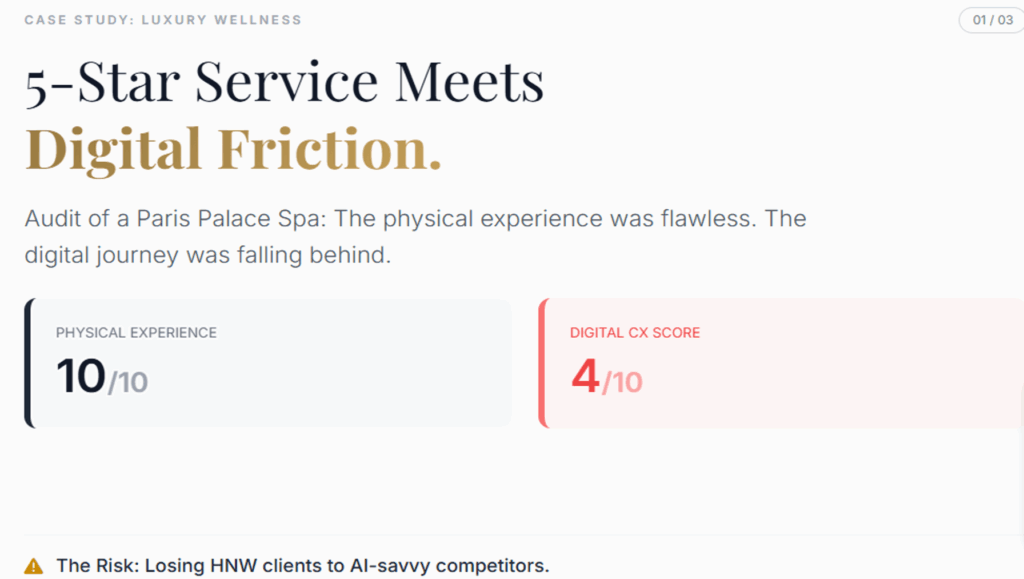
Your 5-star spa service is perfect. But is it invisible?

We recently audited one of the most exclusive Palace Spas in France. The physical experience? A flawless 10/10. The digital reality? A staggering 4/10.

Here is the hard truth for luxury brands in 2025: If you aren’t optimized for the “AI Guest,” you are losing millions to competitors who are.

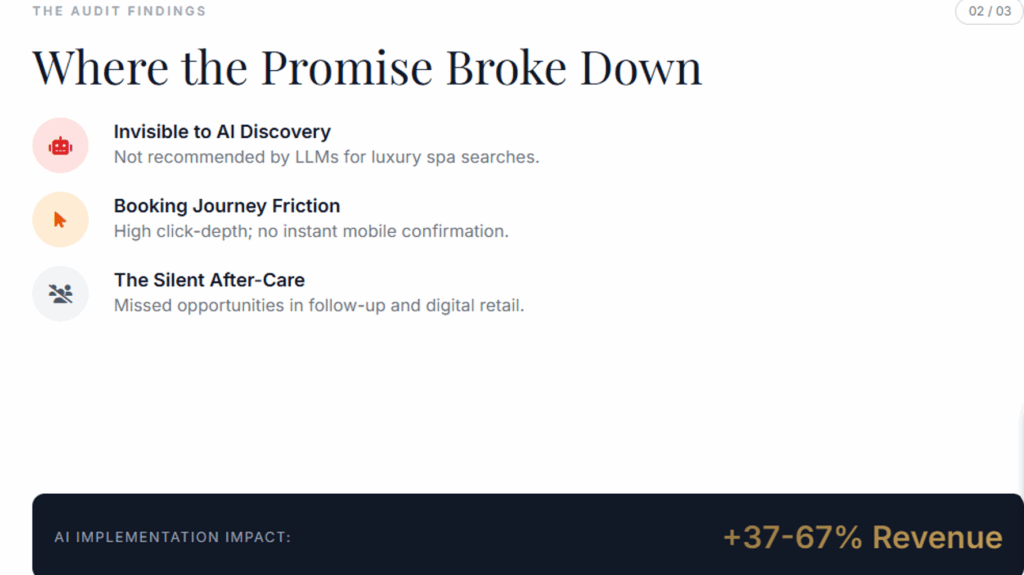
We discovered that when high-net-worth travelers ask ChatGPT or Gemini for the best wellness experiences in France, this iconic brand didn’t even make the list.

Why? The “Luxury AI Gap.”

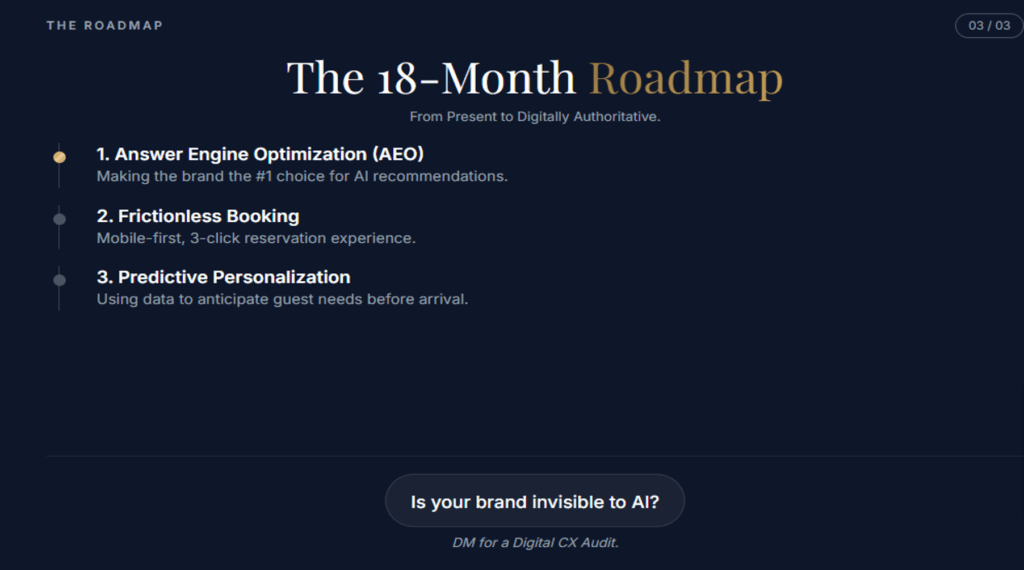
In this 3-slide carousel, we break down:

1️⃣ AI Invisibility: Why LLMs are recommending your competitors over you.

2️⃣ Booking Friction: How a 15-click journey kills high-value conversions.

3️⃣ The 18-Month Roadmap: How to move from “Present” to “Authoritative.”

Luxury is no longer just about what happens on-property. It’s about the frictionless intelligence that leads the guest to your door.

Is your brand invisible to AI? 

👇 Slide through to see the roadmap and message us to discuss how our Digital CX & AI Audit services can help you unlock over double digit additional revenue and client retention.